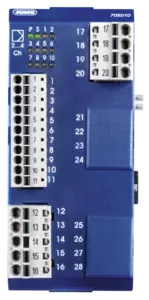
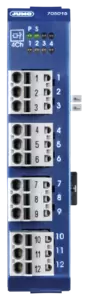
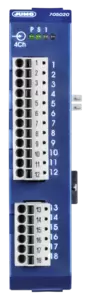
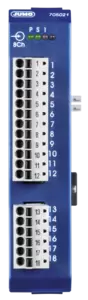
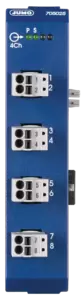
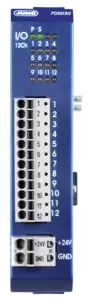
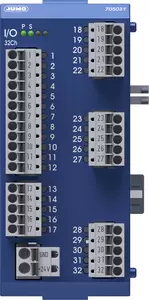
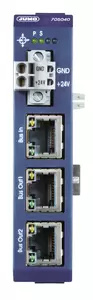
What is an I/O module?
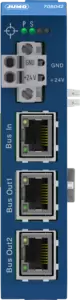
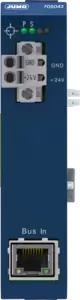
An input/output module, also known as an input/output module or peripheral module, is the interface between the controller and connected sensors and actuators. It converts signals from meters, switches or buttons into signals suitable for processing by the processor. At the same time, it transmits control commands to the connected actuators. Without I/O modules, machines and installations would not be able to process information or be controlled in a targeted manner.
What types of I/O modules are available?
I/O modules can generally be divided into digital and analog:
Digital modules:
- Inputs: accept simple pulse signals, including from keys or limit switches.
- Outputs: transmit control commands to actuators.
Analog modules:
- Inputs: record continuous variables such as temperature, pressure or level.
- Outputs: provide continuous control variables.
In addition, special modules are available to solve specific problems. These include controllers or communication modules.
How is signal conversion done in an I/O module?
Signals need to be adjusted and converted so that controllers and processors can process this information. For analog inputs, this is done using an analog-to-digital converter (ADC), which converts the smooth measured values into digital data. Conversely, a digital-to-analog converter (DAC) converts digital control commands into analog signals for actuators. In addition, modules often perform functions such as noise suppression, level control, or galvanic isolation to ensure reliable signal transmission.
What are the advantages of modular I/O systems?
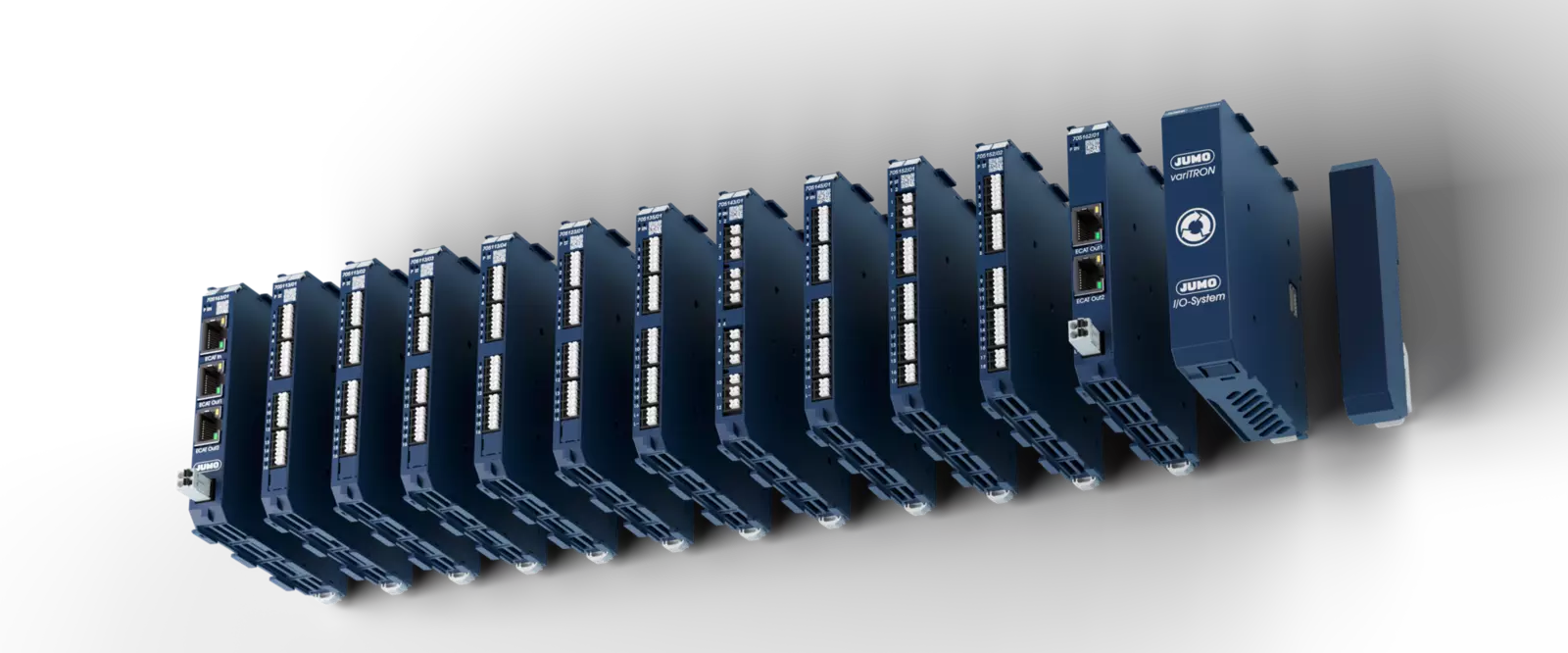
Modular I/O systems are particularly flexible. They can be precisely adapted to your needs and expanded at any time. During maintenance, individual modules can be quickly replaced without the need to shut down the entire system. This reduces downtime and maintenance costs. This makes modular systems attractive for both small machines and complex production systems. The JUMO I/O system is modular in design and can be expanded as needed, providing users with a high degree of flexibility and scalability.
How does a controller module improve the performance and safety of a PLC-based system?
In addition to the classic input and output of process signals, the controller, acting as an input/output module, independently processes and controls these signals in real time directly at the hardware level. Unlike traditional I/O modules, which only act as a signal interface, the controller module integrates local PID control algorithms, which can significantly reduce the load on the PLC CPU. This results in shorter cycle times, improved control quality and increased process reliability - especially in the event of a fault, since the module can continue to control autonomously. This architecture is a unique feature of the JUMO PLC modules, providing decentralized, high-performance control.
What communication protocols do I/O modules use?
Depending on the application and requirements, different protocols are used. Fieldbus protocols include, but are not limited to, PROFIBUS, CANopen, DeviceNet and Modbus RTU. Ethernet-based protocols such as EtherCAT, PROFINET, Ethernet/IP, Modbus TCP and Powerlink provide higher data transfer rates and greater flexibility. The I/O system JUMO uses EtherCAT as its internal communication protocol, which is referred to as the system bus in the technical documentation. In addition to high speed and adaptability, EtherCAT provides extensive diagnostic functions that allow errors to be detected early, which increases system reliability.
What function does a gateway perform in I/O modules?
A gateway is an interface that allows you to connect networks or systems using different communication protocols. In the context of I/O modules, a gateway is used in cases where modules, controllers or control systems must communicate via different fieldbuses. It ensures reliable data transmission, so that signals from sensors and actuators are correctly transmitted to the controller regardless of the bus used. As a result, even heterogeneous plant structures can be efficiently operated and centrally controlled. The JUMO variTRON controllers can also act as gateways due to the large number of supported communication protocols.
How to choose the right I/O modules?
Selecting the appropriate I/O modules depends on a number of factors. First, you need to determine the number of inputs and outputs required, and whether the signals are digital or analog. Equally important is the type of signal: we are talking about whether voltage or current processing is required. In industrial environments, important selection criteria are also a robust design, a high class of protection against dust and moisture, as well as the availability of diagnostic functions.