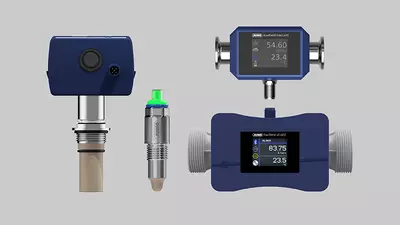
IO-Link: the main thing about the interface
IO-Link links sensors and actuators to the control system for data transfer, parameters and diagnostics.
What is IO-Link?
IO-Link is the first globally standardized interface for fieldbus-independent communication between sensors/actuators and the control layer of an automation system. This technology provides bidirectional data transfer. It also makes it easier to diagnose and configure settings for connected devices.
Sensors with interface IO-Link
How does IO-Link work?
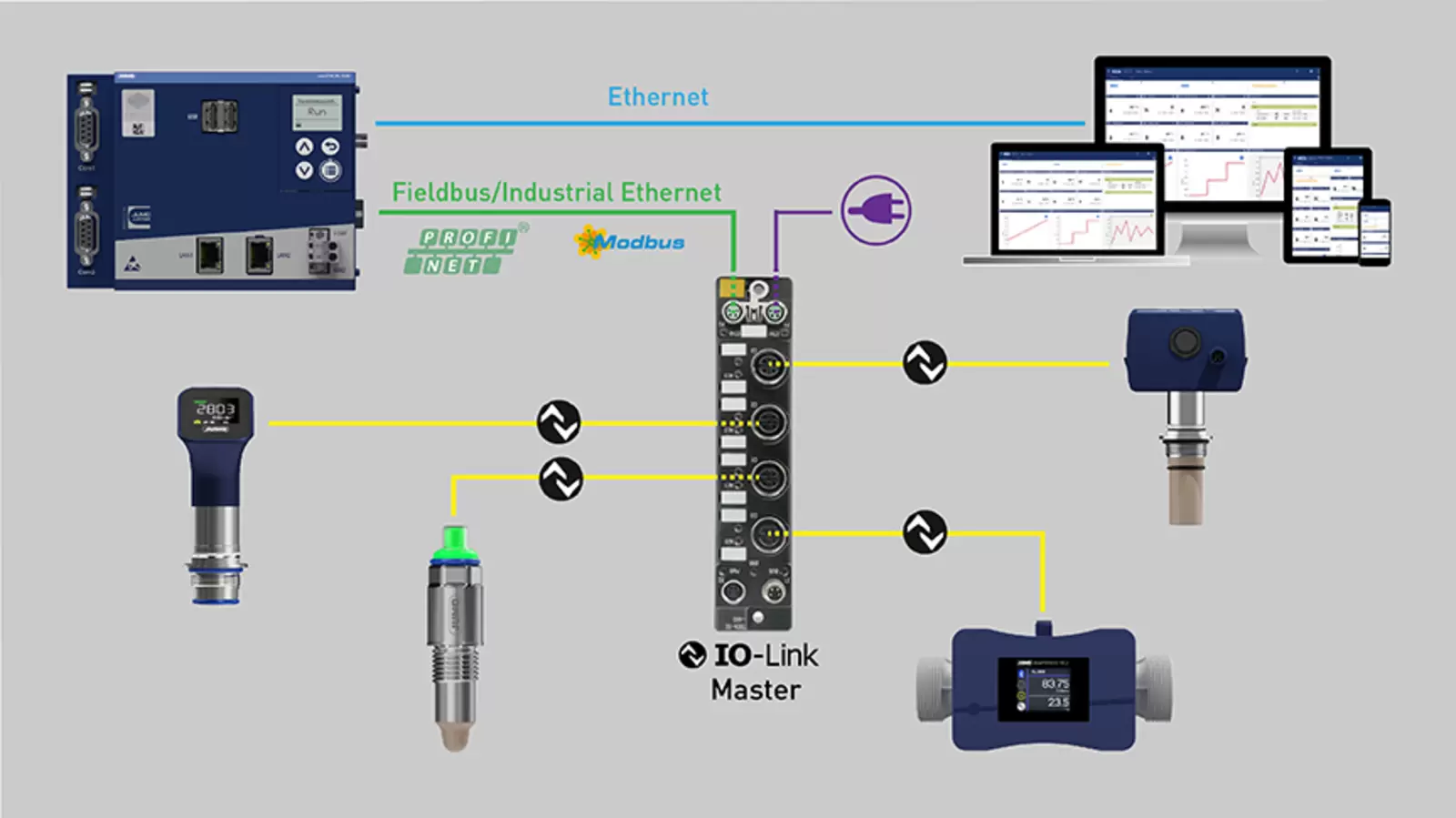
The IO-Link communication is always between two endpoints, namely the IO-Link master and the IO-Link device (sensor/actuator). Data transfer between master and device is carried out using standardized and cost-effective 3-wire or 5-wire cables. Digital data transmission eliminates the typical problems of analog transmission (signal loss, electromagnetic interference, inaccuracy, etc.). The IO-Link master is the link to a higher level automation system or control unit (PLC). Communication is usually via industrial Ethernet (PROFINET, Ethernet/IP, Modbus TCP, etc.).
What components are required for the IO-Link system?
The IO-Link system always consists of several components. These include:
- IO-Link devices (sensors/actuators)
- IO-Link Master
- Connection cables for sensors and actuators (3-wired/5-wired, unshielded)
- Network/power line
- Engineering tool for project planning and parameterization
IO-Link devices
IO-Link devices (or IO devices) include RFID sensors, actuators or readers that communicate directly with the IO-Link master via the IO-Link protocol. Their significant advantage is the ability to transmit process data as well as service and diagnostic data such as operating states or error messages.
Master IO-Link
The IO-Link master is the central component of the IO-Link system and serves as the link between the IO-Link devices (field level) and the control unit (control level). It provides multiple IO-Link ports (usually 4 or 8) for connecting devices, collects data from connected devices and transmits it as a packet to a higher level control unit. It supplies the devices with voltage, controls them and takes over the configuration as well as diagnostics of the devices.
In addition, it offers various error detection functions and simplifies the integration of existing IT systems, which significantly increases the efficiency and flexibility of automation solutions (especially in the context of Industry 4.0). As a rule, the wizard has a built-in web server, which provides remote access and allows you to use all functions directly over the network.
Sensors with interface IO-Link
What is IO-Link Safety?
IO-Link Safety is an extension of IO-Link technology designed specifically for safety-critical applications in industrial environments. It allows security functions to be integrated into the IO-Link architecture. In addition, it extends the existing IO-Link standard to include safety-related communication between sensors or actuators and the safety controller.
What is IO-Link Wireless?
Similar to the IO-Link Safety, the IO-Link Wireless is also an extension of the traditional IO-Link that allows sensors and actuators to be connected to control systems wirelessly. This means that IO-Link communications can occur wirelessly without a physical cable connection, improving installation, flexibility and scalability in industrial environments. IO-Link Wireless is often used for system components that are difficult to access or move, as well as for costly and complex installations.
What is IODD?
The abbreviation IODD stands for “I/O Device Description” (IO Device Description). This is a file that describes the characteristics of the IO-Link device. It contains important information such as the device type, manufacturer ID, communication settings, and detailed information about the device's features. IODD allow the IO-Link master and higher-level systems to automatically recognize connected devices and configure them correctly.
What is the standard IEC 61131-9?
The IEC 61131-9 standard is an international standard designed specifically for communication between controllers and devices in industrial automation systems. It defines the technical specifications of "single-link digital communication interfaces (SDCI)", commonly known as IO-Link.
Sensors with interface IO-Link
What advantages does the IO-Link offer in industrial communications?
The IO-Link architecture offers many benefits, from optimizing production processes to reducing maintenance costs:
Optimization of the production process through communication at the lowest field level
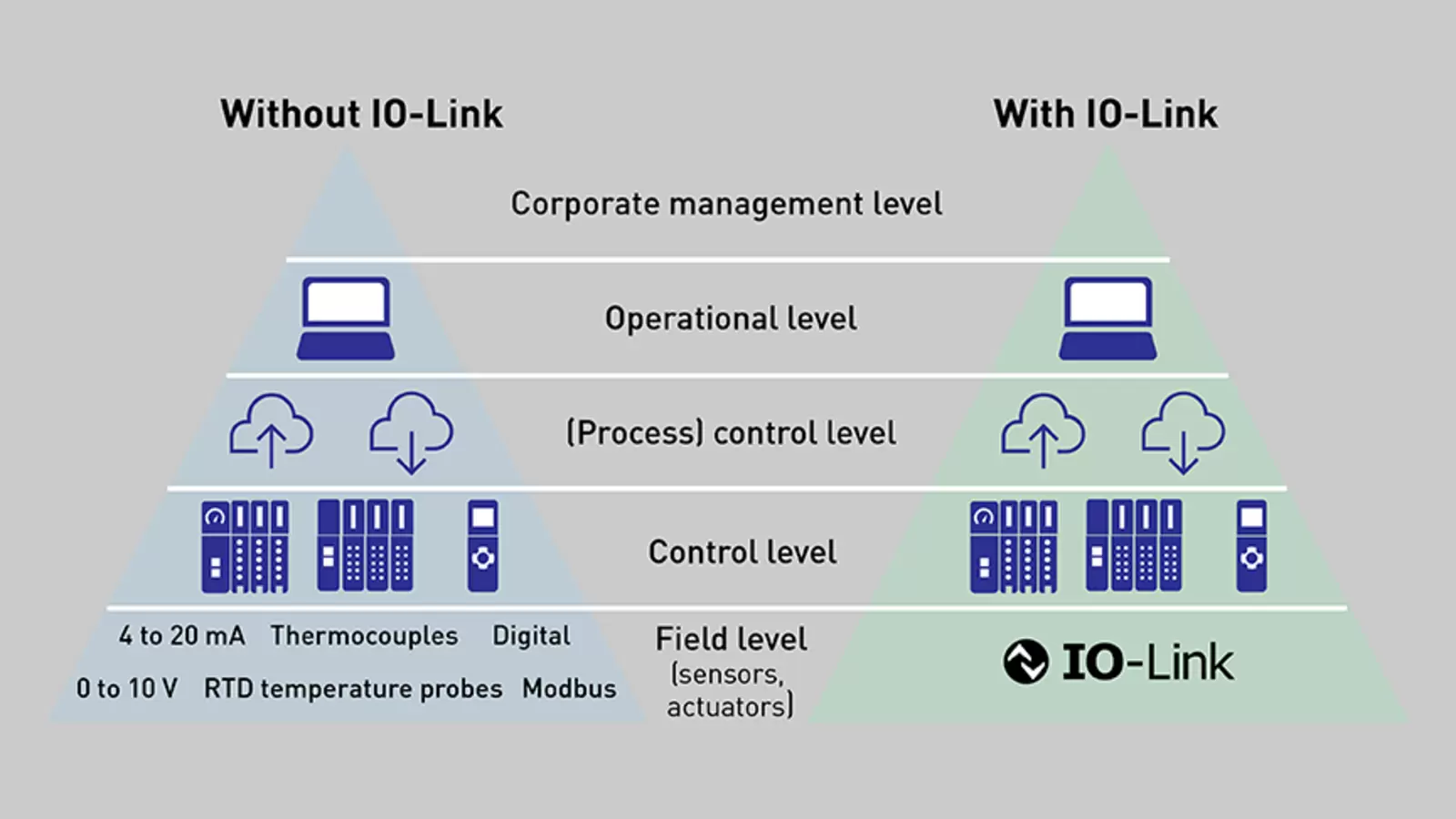
Flexibility, productivity and remote maintenance are important parameters for the performance of machines and plants. Sensors with IO-Link now give the plant operator access to the lowest field level. For optimal installation health assessment, minimal effort is required to obtain sensor information, configuration parameters and diagnostic data.
Reduced installation and startup time
Using IO-Link can significantly reduce installation and startup costs. This is made possible by simplified cabling and the ability to automate startup by saving and duplicating parameters.
Installation uses ready-to-install cables, eliminating assembly and eliminating sources of error. Startup is also possible through automation, as parameters can be downloaded and made available to the device in seconds.
Thanks to fieldbus independence, inventory variations are significantly reduced and each sensor always has its own “identity card” in the form of IODD.
Increase plant efficiency through maximum transparency down to the sensor level
Modern IO-Link systems avoid situations where installations unexpectedly stop due to a faulty sensor. After all, the functions built into the sensors (such as hour meters, tightening indicators, fault and short circuit detection) help identify and eliminate critical sensor conditions at an early stage, which significantly increases the efficiency of the installation.
IO-Link offers the ability to exchange cyclic and acyclic data with higher levels. For example, parameter data can be downloaded to the sensor or diagnostic data can be retrieved during operation. Data is exchanged quickly and is available within seconds with baud rates of COM3 230,4 kbaud and cycle times of less than 1 ms in some cases.
Reliable identification of sensors using device ID IO-Link and IODD
The Device ID is a unique identifier assigned by the manufacturer to each IO-Link device. It allows the technician to clearly identify the connected device and assign it an appropriate description (IODD - IO Device Description).
Once IODD is imported into the master, the master recognizes all device characteristics. For a sensor, these can be characteristics such as sensor type (temperature sensor, pressure sensor, etc.), measurement range or accuracy class. IODD also contains various information about the device manufacturer, such as the manufacturer's name, manufacturer's logo, or URL manufacturer's address. When a sensor is connected to a master port, the device IDs are synchronized.
If the sensor device ID does not match the IODD stored for that port, an error is immediately detected and reported. As a result, any replacement of sensors with different measuring ranges or accuracy classes can be immediately detected. A “wrong” sensor can be replaced immediately after installation rather than during operation, reducing downtime.
What is the speed of IO-Link?
A total of 3 different baud rates are available. They are designated COM1, COM2 and COM3:
- COM1: 4,8 kbaud
- COM2: 38,4 kbaud
- COM3: 230,4 kbaud (fastest)
Each IO-Link device can operate at one of three baud rates and, as a result, determines the link speed for the corresponding port. Thus, one IO-Link master can handle all three baud rates.
What is the IO-Link profile?
The IO-Link profile is a standardized set of functions and parameters defined for specific types of devices or applications. These profiles simplify integration and data exchange between IO-Link devices because they use the same features and data formats regardless of manufacturer. The following profiles are currently available:
General profile
A common profile provides a basis for standardizing certain functions across different device types. It defines key parameters and functions that are relevant to many IO-Link devices, regardless of their specific application. This simplifies the integration and management of devices from different manufacturers in the IO-Link system.
Smart Sensor Profile
The Smart Sensor Profile is specifically designed for smart sensors and includes advanced features beyond the basic functionality of a simple sensor. These may include advanced diagnostic data, condition monitoring features, and self-tuning capabilities. This profile allows sensors not only to collect data, but also to process and transmit information about their condition and performance, which can be critical for maintenance (preventive maintenance).
Firmware update profile
The Firmware Update Profile defines a standardized process for updating the firmware of IO-Link devices over the IO-Link connection. This profile is especially important because it allows devices to be maintained and updated in the field without having to physically access or replace them. This means that updates can be completed faster and at a lower cost.
The IO-Link community is already working on additional profiles that will further expand the functionality and benefits for users. Examples include the Intelligent Drive profile, the Lighting and Display profile, and the Intelligent Power Systems profile.
Sensors with interface IO-Link
What is the IO-Link community?
The IO-Link Community is an organization dedicated to the further development, standardization and dissemination of IO-Link technology. It was created within the User Organization PROFIBUS (PNO), which in turn is one of the largest industrial communications communities worldwide. This community consists of a large number of manufacturers, developers, system integrators and users working in the field of automation and industrial technology.
What are the development prospects for IO-Link?
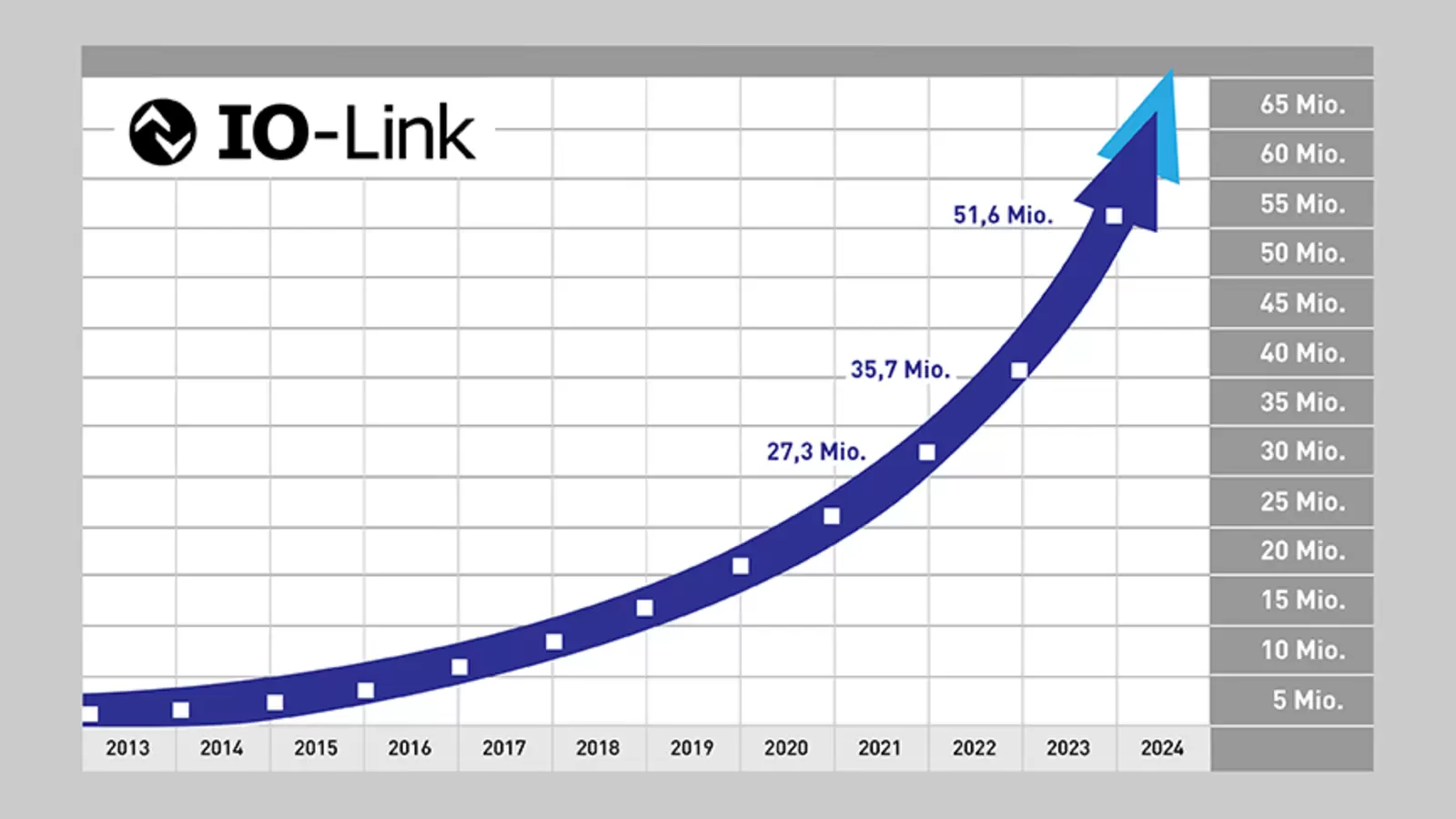
As technology develops and improves, more companies recognize the benefits of the IO-Link. More than 35 million IO-Link devices were installed in 2023, up 8,4 million from the previous year. One reason is the ongoing development of Industry 4.0 and Industrial Internet of Things (IIoT) applications, for which IO-Link is ideally suited.
Are there any challenges associated with implementing IO-Link?
While IO-Link offers many benefits, implementation can be challenging, especially in terms of training and integration into existing systems. The need for careful planning and possibly adaptation of existing infrastructure may incur initial costs, but these are well worth the long-term cost savings and increased efficiency. To ensure smooth and efficient integration into existing systems, it is definitely worth taking the help of an expert.
Our services for you