Pressure
Pressure measurement
Despite the international SI system, technical characteristics such as technical atmosphere (at), physical atmosphere (atm) or psi (pounds per square inch) can still be found in engineering.What is the unit Pascal (Pa)?
The pascal (Pa) is the SI unit of pressure and is also used for atmospheric pressure. If the weight of a 100 g mass acts on an area of 1 m² (F = 0.1 kg × 10 m/s² = 1 N), the resulting pressure is 1 Pa.
1 Pa = 1 N/m2
The following sections also use MPa and hPa: megapascal (10⁶ Pa) and hectopascal (10² Pa = 100 Pa), respectively.
Pressure measuring instruments
When is pressure expressed in bars?
The usual unit for higher pressures in Europe is the bar (bar), since Pascal (Pa) is too small a unit for most engineering applications. Below you will find the conversion from 1 bar to the corresponding pressure value in Pa unit.
1 bar = 105 N/m2 = 100 000 Pa
1 bar corresponds approximately to the pressure exerted by a mass 1 kg over an area 1 cm2 or 10 t over 1 m2.
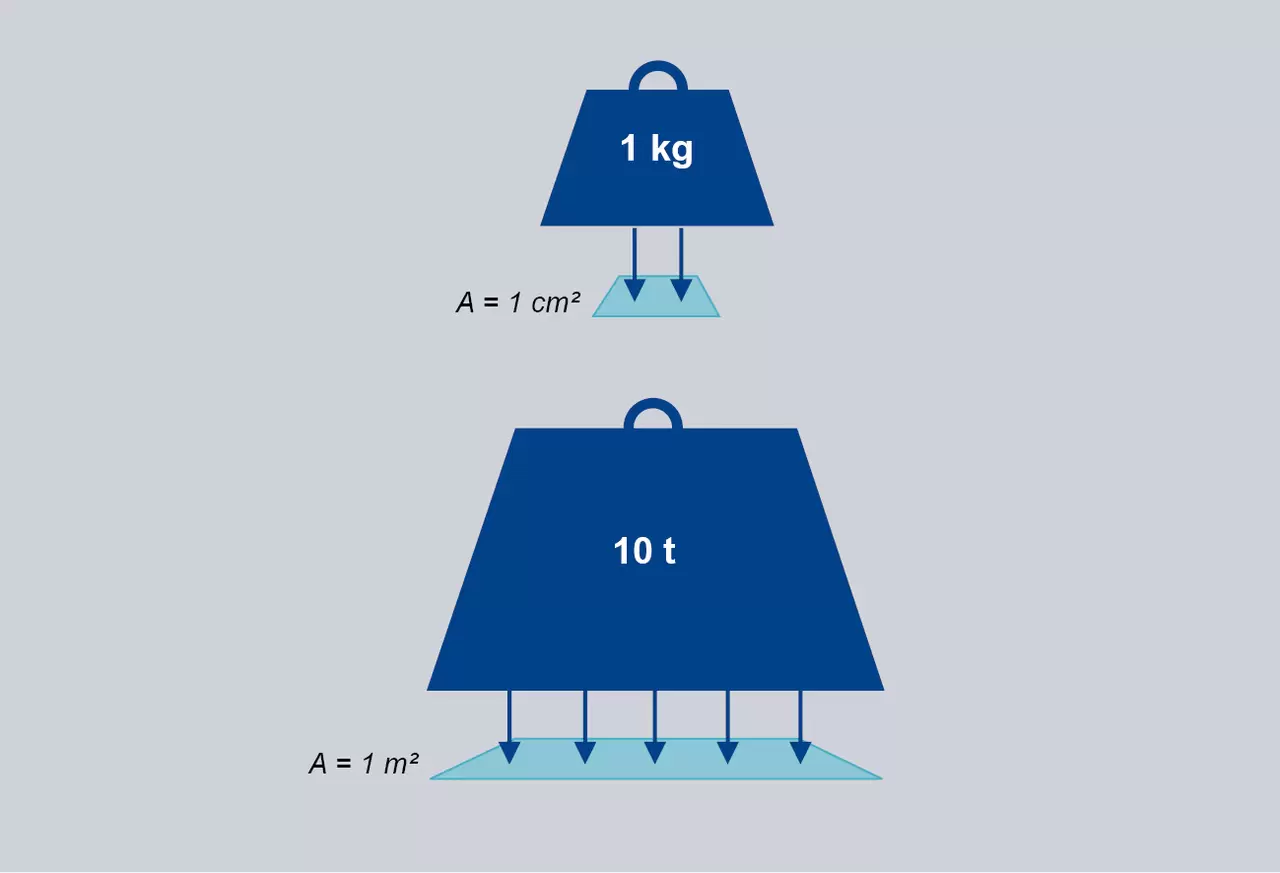
*Note: The exact value of acceleration due to gravity g = 9,81 m/s2 was not used here, but was rounded up to 10 m/s2.
convert to bar | |
|---|---|
| value | |
| 1 Pa | 0,01 |
| 1 hPa | 1 |
| 1 psi | 68,97 |
| 1 mH₂O | 98,07 |
| 1 mmHg | 1,333 |
| 1 Torra | 1,333 |
| 1 at | 980,07 |
| 1 atm | 1013,3 |
What other units of pressure are used?
The pressure settings for Atm and Atm were replaced by the unit bar in 1978 and since then are no longer among the legal German pressure units. However, their history is interesting and shows a connection with other, partly still common units of pressure:
Technical atmosphere
The technical atmosphere is defined using the hydrostatic pressure of a 10 m water column. For a density of ρ = 1 kg/dm³ and standard acceleration of free fall g = 9.80665 m/s²:
1 at = 0.980665 bar = 10 mH₂O
The technical atmosphere is usually accompanied by an indexical character, depending on whether it is absolute pressure (ata), negative pressure (atu) or gauge pressure (atü), such as is prevalent in tire pressure testers at service stations.
Physical atmosphere
Physical atmosphere reference atm - the average atmospheric pressure prevailing at sea level, caused by the force of the weight of the Earth's atmosphere.
Atm pressure:
1 atm = 1,01325 bar = 760 Torr = 760 mmHg.
Millimeter of mercury (mmHg)
A millimetre of mercury (mmHg) is the pressure of a 1 mm mercury column at a density of 13.5951 g/cm³ and standard acceleration of free fall of 9.80665 m/s². This unit is almost equal to the torr (Torr).
Pressure unit mmHg:
1 mm Hg = 133,322387415 Pa
The millimeter mercury column is not one of the SI compatible pressure units, but is the legal unit used in medicine for diagnosing blood pressure in the EU and Switzerland.
Pounds per square inch
The unit commonly used in the United States is pounds per square inch (psi). However, related information in product specifications or data specifications is usually given in psi (pounds per square inch).
Pressure device psi:
1 psi = 1 lbf/in2, where lbf is the pound-force: the force acting on a mass of 1 pound at the standard acceleration of free fall g = 9.80665 m/s21 psi ≈ 6 894.75729 Pa ≈ 6.89475729 kPa
Conversion of pressure units
The following information allows you to easily convert between the most common pressure units:
- 1 bar = 100 000 Pa = 0.1 MPa ≈ 1.01972 at ≈ 0.986923 atm ≈ 750.06168 Torr ≈ 750.06158 mmHg ≈ 14.50377 psi
- 1 megapascal (MPa) = 1 000 000 Pa = 10 bar ≈ 10.19716 at ≈ 9.86923 atm ≈ 7 500.61683 Torr ≈ 7 500.61576 mmHg ≈ 145.03774 psi
- 1 pound-force per square inch (psi) ≈ 6 894.76 Pa ≈ 0.06895 bar ≈ 0.07031 at ≈ 0.06805 atm ≈ 51.71 Torr ≈ 51.71 mmHg
- 1 metre of water column (mH₂O) = 9 806.65 Pa = 0.0980665 bar = 0.1 at ≈ 0.096784 atm ≈ 73.56 Torr ≈ 73.56 mmHg ≈ 1.42 psi
- 1 millimetre of mercury (mmHg) ≈ 133.322 Pa ≈ 0.00133322 bar ≈ 0.00135951 at ≈ 0.00131579 atm ≈ 1.000000142 Torr ≈ 0.0193 psi
- 1 torr (Torr) ≈ 133.322 Pa ≈ 0.00133322 bar ≈ 0.00135951 at ≈ 0.00131579 atm ≈ 0.999999857 mmHg ≈ 0.0193 psi
- 1 technical atmosphere (at) = 98 066.5 Pa = 0.980665 bar ≈ 0.967841 atm ≈ 735.55924 Torr ≈ 735.55914 mmHg ≈ 14.22334 psi
- 1 standard atmosphere (atm) = 101 325 Pa = 1.01325 bar ≈ 1.033227 at = 760 Torr ≈ 759.99989 mmHg ≈ 14.69595 psi
Pressure units in everyday life
The specifications of the JUMO TAROS S47 P pressure transmitter provide an example of pressure units in use. For the version with a gauge pressure measuring range of 0 to 6 bar, the burst pressure is 60 bar. At this pressure, the instrument suffers irreversible damage: 60 bar = 6 MPa ≈ 61.183 at ≈ 59.215 atm ≈ 870.226 psi ≈ 45 003.69 mmHg.
Another example is a differential pressure transmitter for non-aggressive gases with an input range of 0 to 5 mbar. The maximum measurable differential pressure is 5 mbar = 0.005 bar = 500 Pa = 5 hPa ≈ 0.0051 at ≈ 0.00493 atm ≈ 0.0725 psi.
Devices and services JUMO