Pressure measurement
Pressure as a physical quantity. Pressure is one of the physical quantities most frequently measured and controlled in automation. It directly affects production and industrial processes. This article explains the fundamentals of pressure and pressure measurement.Contents
What is pressure
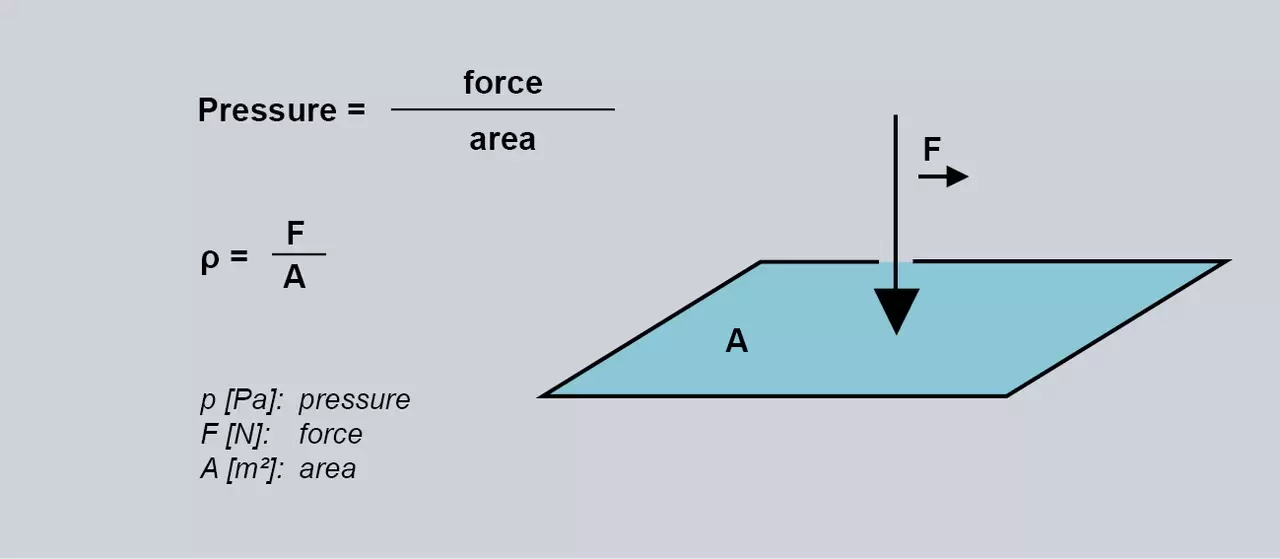
Pressure p is defined as the force F divided by the area A.
The force acts perpendicular to the surface and is distributed over its entire area.
The SI unit for pressure is Pascal (Pa).
1 Pa=N/m²
text
The force F always has a direction (here: vertical) and is therefore a vector. Pressure p, on the other hand, has no direction - it is scalar. Within a closed system, such as a pressure reservoir, pressure always acts perpendicularly on all surfaces equally. In practice, this means that the mounting position of the pressure transducer or diaphragm can be chosen arbitrarily. For example, compressor accumulator pressure can be measured by mounting a pressure transducer on the top of the reservoir with the diaphragm pointing down.
What units of pressure are used in the world?
If the weight of a 100 g mass acts on an area of 1 m² (F = 0.1 kg × 10 m/s² = 1 N), the resulting pressure is 1 Pa.* For higher pressures, the bar (bar) is commonly used in Europe.
1 bar = 10⁵ N/m² = 100 000 Pa
The bar (bar) is commonly shown on the scales of pressure gauges and process variable recorders. In medicine, the millimetre of mercury (mmHg) is often used, including for measuring systolic blood pressure.
1 mmHg ≈ 133.322 Pa
Pressure measuring instruments
What is the formula for pressure of a liquid or gas?
By definition, a force F = 1 N acting on an area A = 1 m² produces a pressure of 1 Pa. For example, at an approximate acceleration of free fall g = 10 m/s², a mass m = 100 g has a weight of 1 N.
Formula and unit of pressure:
p = F/S, where:
p - pressure [Pa]
F — force [N]
S — area [m2].
You can use the above formula to calculate pressure if you know the mass of the object or medium being tested. But what if you need to calculate the pressure at the bottom of a large container such as a swimming pool? In this case, it is impossible to determine the total mass of water. Using the formula, you can determine the pressure at the bottom of the container based solely on the density and height of the medium column:
Pressure formula:
p = ρgh +p0Where:
ρ — medium density [kg/m3]
g — acceleration of free fall [m/s2].
h is the height of the liquid column [m].
*Note: The exact value of acceleration due to gravity g = 9,81 m/s2 was not used here. Instead, the rounded value 10 m/s2 was used.
What types of physical pressure exist?
Absolute pressure
The zero point of the absolute pressure scale is a vacuum. Absolute pressure is therefore always measured relative to a vacuum. Atmospheric pressure, for example, is expressed as Absolute pressure..
overpressure
When measuring
excess pressure, reference value - ambient pressure value. In industrial applications, equipment pressure is often specified in relative form, i.e. in relation to atmospheric pressure. In this case, the actual pressure is the sum of the excess pressure (as it occurs in the process) and the ambient pressure (atmospheric). In industry, however, processes often occur at pressures that are many times higher than atmospheric pressure. In such cases, ambient pressure is not taken into account.
Static and dynamic pressure in liquid
Static pressure is the pressure in a gas or liquid at rest, such as in a closed container. In this case, it is enough to know the force exerted by the medium on a given surface to determine the pressure. However, if the medium is in motion, such as in a pipeline, it is called dynamic pressure. By definition, dynamic pressure can be described as the pressure exerted by a flowing fluid or gas on the surface of a body at right angles to the flowing medium. This pressure is the result of the kinetic energy of the moving particles.
Differential pressure
The differential pressure is the result of comparing two absolute pressure values and is called the pressure difference Δp. It is often used in engineering applications for control purposes. For example, the difference in pressure at the bottom of a liquid container and above the liquid provides information about the height of the liquid column. A differential pressure gauge, such as a differential pressure transmitter, makes pressure measurements at two measurement points.
Hydrostatic pressure
Hydrostatic pressure occurs in a liquid at rest. It depends on the height of the liquid column h, its density ρ and acceleration due to gravity g. The higher the water column, the higher the pressure. The deeper a diver dives into a lake, for example, the greater the hydrostatic pressure acting on him.
Devices and services JUMO