

Static and dynamic pressure in liquid
Pressure measurement
The physical laws of fluid mechanics apply to static and flowing fluids, resulting in a distinction between static pressure and dynamic pressure. Learn more about the behavior, possible applications and differences between the two pressures!How are static and dynamic pressure related?
When liquids are at rest, i.e. when there is no flow, only static pressure (pstat) acts on them, and this acts equally in all directions.
Once the medium flows, for example in pipes, conditions become somewhat more complex. Kinetic energy increases the force effect in the direction of flow. If this force hits a body that is in a flow, a pressure acts on its surface: this is called dynamic pressure (pdyn), also known as dynamic pressure. This is calculated from the density ρ and velocity v of the medium:
pdynamic = ρ/2 ⋅ v2
However, there is no additional force perpendicular to the flow. Only static pressure acts here. The sum of both pressures is called the total pressure (pges).
pthat one=pstat+pdynamic
Pressure measuring instruments
Where are static and dynamic pressure taken into account?
Static pressure is important for most pressure measurements. One exception is flow velocity measurements, which are calculated using dynamic pressure. Examples of applications are measuring speed on airplanes or recording wind speed on wind turbines. Both use a Prandtl pitot tube in which the static pressure opposes the total pressure and displays the net dynamic pressure.
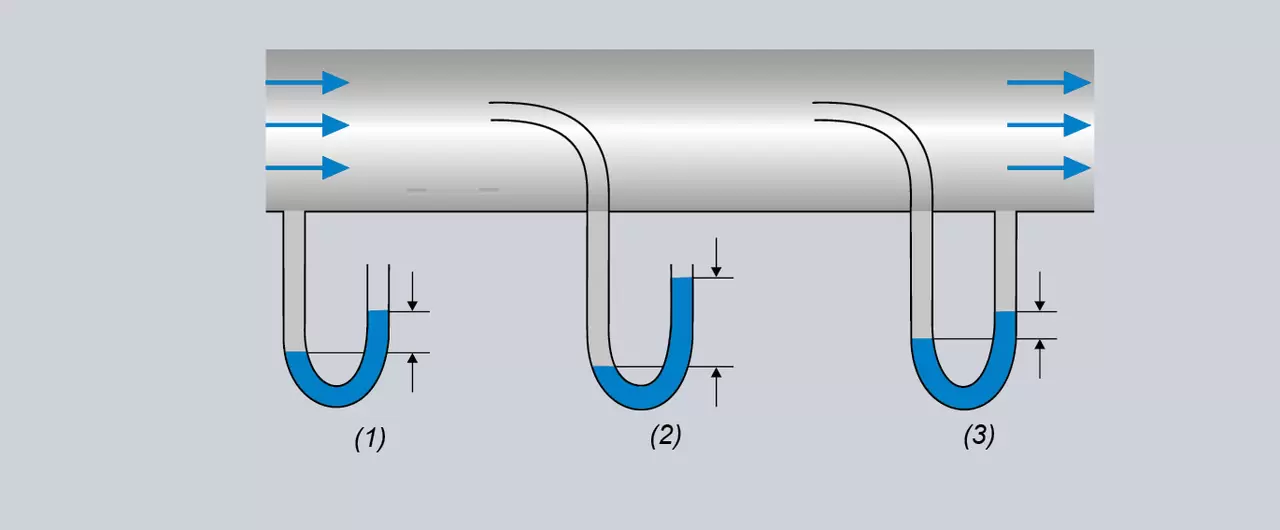
What does Bernoulli's equation describe?
To stay within the definition of total pressure, it is important to mention a fundamental law of fluid dynamics, namely Bernoulli's law, which rightly assumes that the sum of static and dynamic pressure is constant along any given line of flow.
p + ρgh + (ρ × v2)/2 = constant
The rod p + ρgh is responsible for the static pressure and the rod (ρ × v2)/2 for the dynamic pressure. Since the sum of the two pressures has a constant, unchanging value, it can be assumed that the pressure pstat decreases as the fluid velocity increases. Using the above law, it is possible to calculate, for example, the speed of the liquid leaving the hole at the bottom of the tank based on the height of the liquid column in the tank.
Application examples
Static pressure in a central heating system is an extremely important component for the correct operation of the system. For example, the static pressure must be lower than the opening pressure of the safety valve and at the same time higher than the water column pressure. Knowing the water column pressure is necessary to avoid system malfunctions and reduced heating output.
Devices and services JUMO