Temperature measurement
Thermocouples: device and application
Thermocouples measure temperature over a wide range. They are used, for example, in industrial furnaces and heat treatment plants. Find out how a thermocouple works, how to choose its type and connect it to the device.
What is a thermocouple?
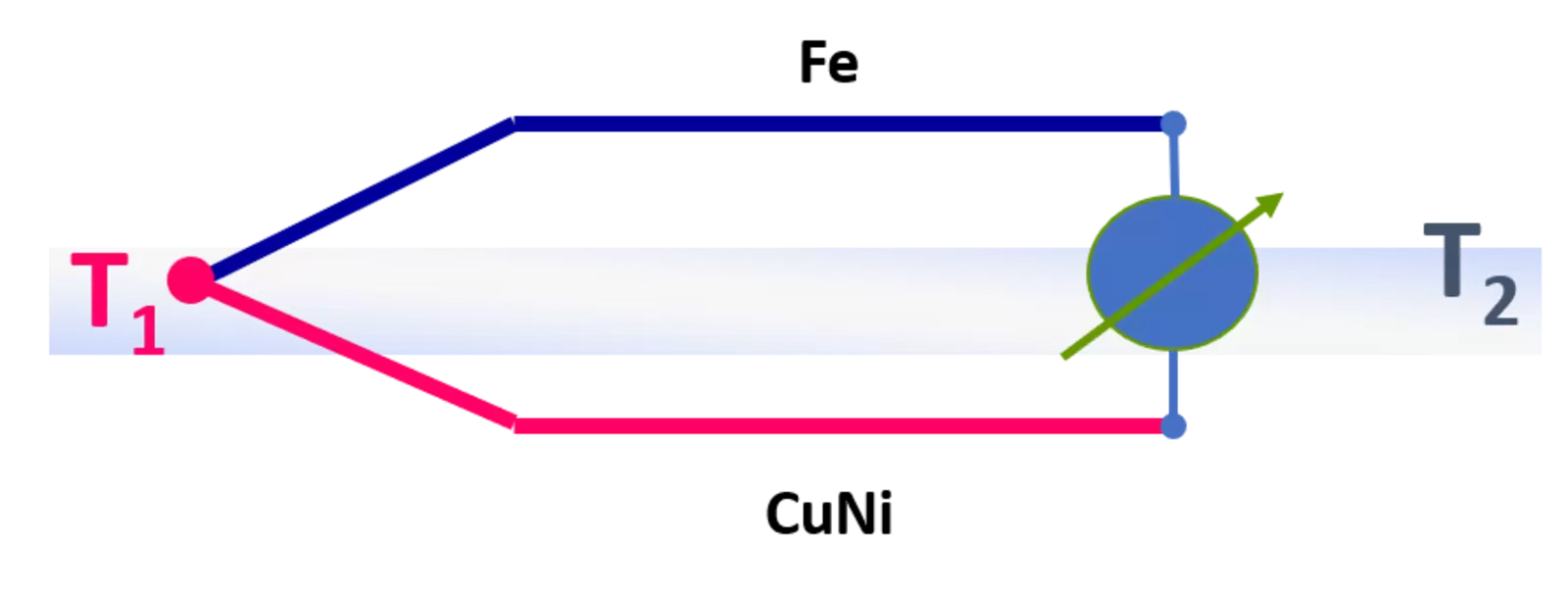
A thermocouple consists of two conductors made of different materials. The conductors connected at the measuring end create a thermoelectric voltage, which depends on the temperature difference between the measuring and reference junctions.
How does a thermocouple work?
Sensitive conductors are isolated from each other along their entire length, except for the working junction. In the industrial version, the junction is protected by a sheath or sleeve, and the terminals are connected to terminals or a connecting cable.
What properties are important for a thermocouple?
The thermoelectric voltage should depend reproducibly on temperature. Conductor and protective sheath materials are selected taking into account the operating environment, temperature, load and response time.
How is a thermocouple different from a resistance thermometer?
A thermocouple produces thermoelectric voltage, and a resistance thermometer determines temperature by changes in electrical resistance. Thermocouples are often used at high temperatures, and platinum resistance thermometers are often used when stability and accuracy over the operating range are especially important.
What metal pairs are used in thermocouples?
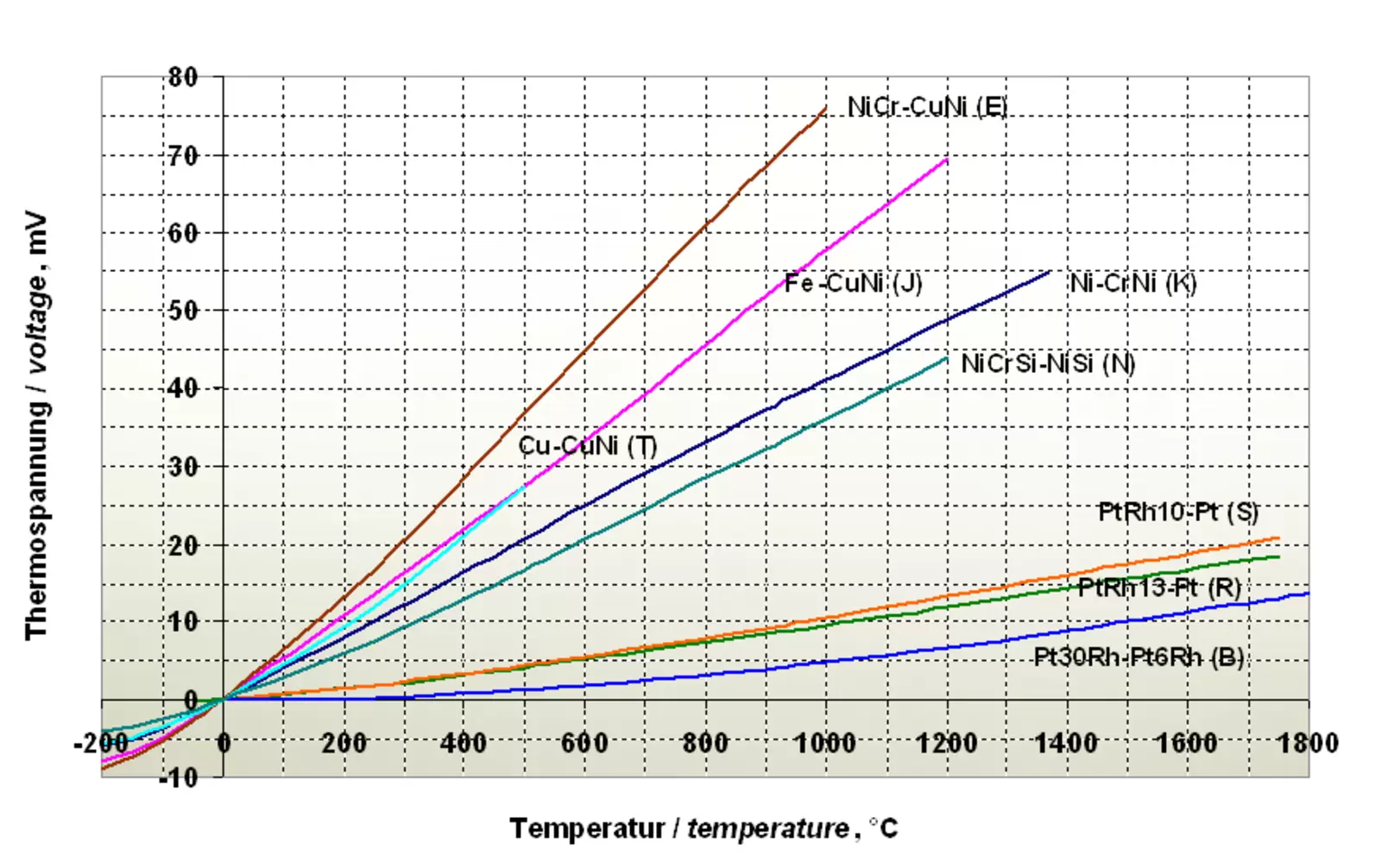
The thermocouple type is indicated by a letter. This letter defines the material combination and the voltage/temperature rating. Check the permissible temperature of the finished sensor based on its design.
| Type | Positive conductor | Negative conductor |
|---|---|---|
| J | Iron | Copper-nickel |
| T | Copper | Copper-nickel |
| K | Nickel-chrome | Nickel |
| E | Nickel-chrome | Copper-nickel |
| N | Nickel–chrome–silicon | Nickel-silicon |
| S | Platinum-rhodium 10 % | Platinum |
| R | Platinum-rhodium 13 % | Platinum |
| B | Platinum-rhodium 30 % | Platinum-rhodium 6 % |
How does a thermocouple work?
At different temperatures, thermoelectric voltage arises at the ends of the conductors. The measuring device converts it into temperature according to the characteristic of the selected type and takes into account the temperature of the reference junction.
How to choose a thermocouple?
Specify the operating range, permissible error, installation conditions and medium composition. The type of thermocouple, sheath material, immersion depth and connection method depend on these requirements.
How to connect a thermocouple?
Observe polarity and use extension or compensation wires compatible with the thermocouple type. Set the measuring input to the appropriate type and check the reference junction temperature compensation.
What to do in case of a short circuit or break?
When closed, the new contact can become a measuring point. If there is a break, the device loses the measuring signal and, depending on the settings, generates a fault signal. Check the continuity of the circuit and connections with the equipment safely disconnected.
What thermocouple lengths are available?
The available installation length depends on the design, mounting method and material of the protective sheath. Dimensions of standard versions are given in the data sheet.
Is it possible to order a thermocouple of non-standard length?
For a number of designs, dimensions can be adjusted to suit the task. Please indicate the required installation length and operating conditions when requesting a quote.