
Individual approach and single source
We offer not only industrial thermostats, but also comprehensive customized solutions, including feasibility studies.
Contact us!
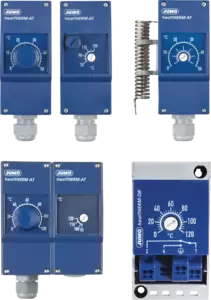
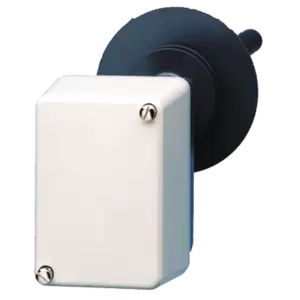
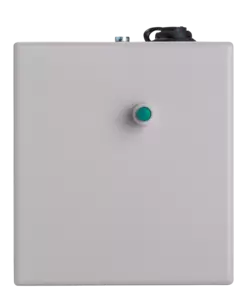
Thermostats JUMO have a tradition of more than 50. Thanks to the high level of in-house production and continuous improvement, they operate reliably in a wide variety of industries around the world. Shop electronic and electromechanical thermostats in a wide variety of housing sizes, specifications and lot sizes to find the right option for your application.
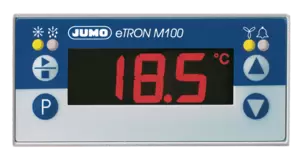
Very precise control results are achieved using thermostats. They measure temperature using a temperature sensor and, like PID controllers, adjust the temperature exactly to the set point. In the case of binary control, precise control is possible by changing the relative switching time of the actuator. For example, the heating power can be changed from 0 to 10 kW.
Temperature switches, on the other hand, are intermittent on-off controllers - the process temperature fluctuates with them around a set point. In many applications, such temperature fluctuations are acceptable, so temperature switches can be used to provide very reliable temperature control at low cost.
As the name suggests, bimetal is used in bimetallic switches. Two metals wound around each other (such as copper and nickel) have different coefficients of expansion. As the temperature increases, the metals expand to varying degrees, which leads to the contact deflection and its opening (NC) or closing (NO).
Bimetallic switches in industrial applications have a very compact design and are usually screwed into the process as a sensor. The switching point is fixed during production. They are also very resistant to vibration - vibration resistance up to 10g is not uncommon. The switches are connected to the evaluation system via a connecting line. Bimetallic temperature switches are used in equipment such as compressors - they switch off the compressor when the temperature is exceeded or start active cooling (for example, a fan).
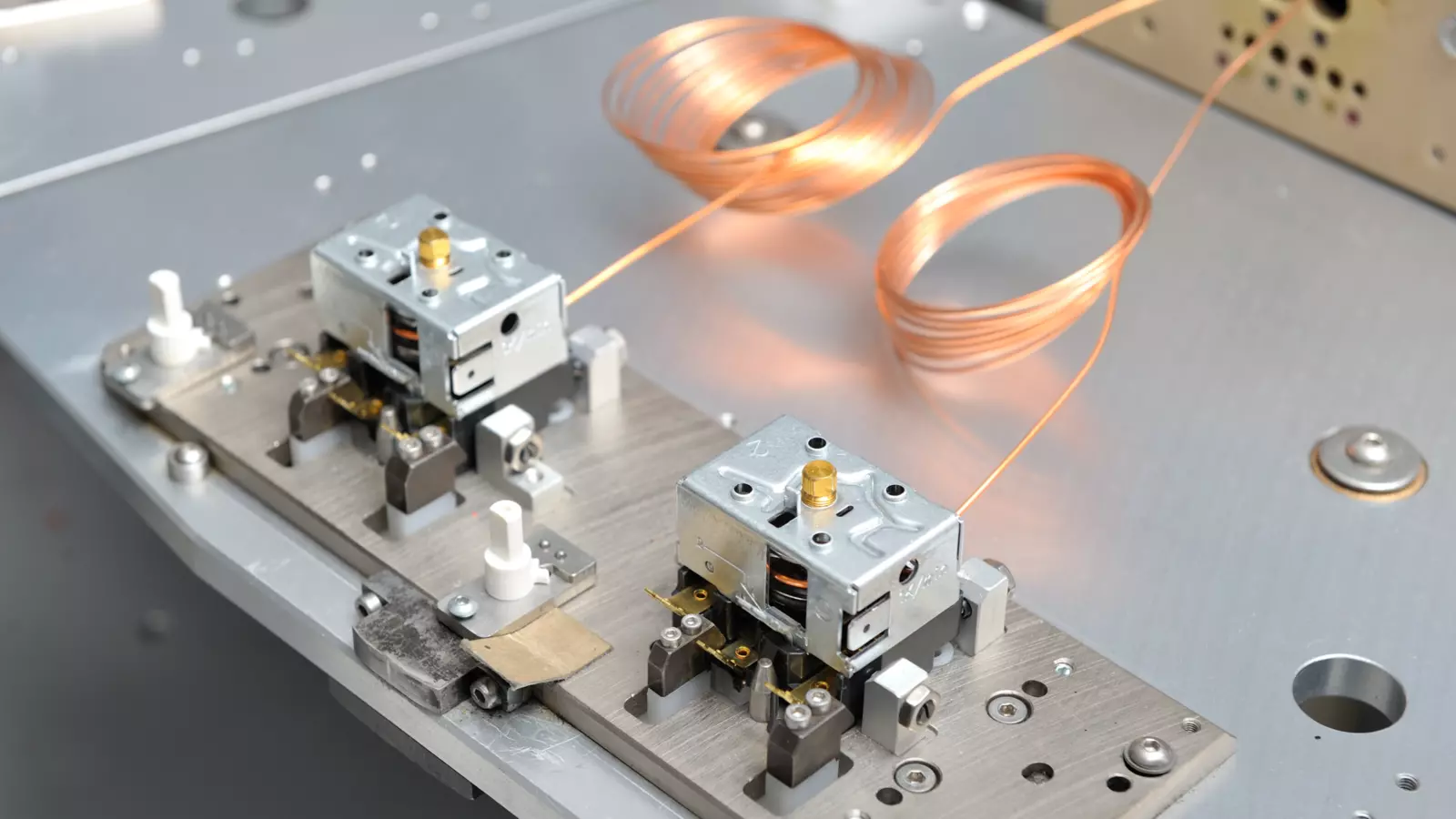
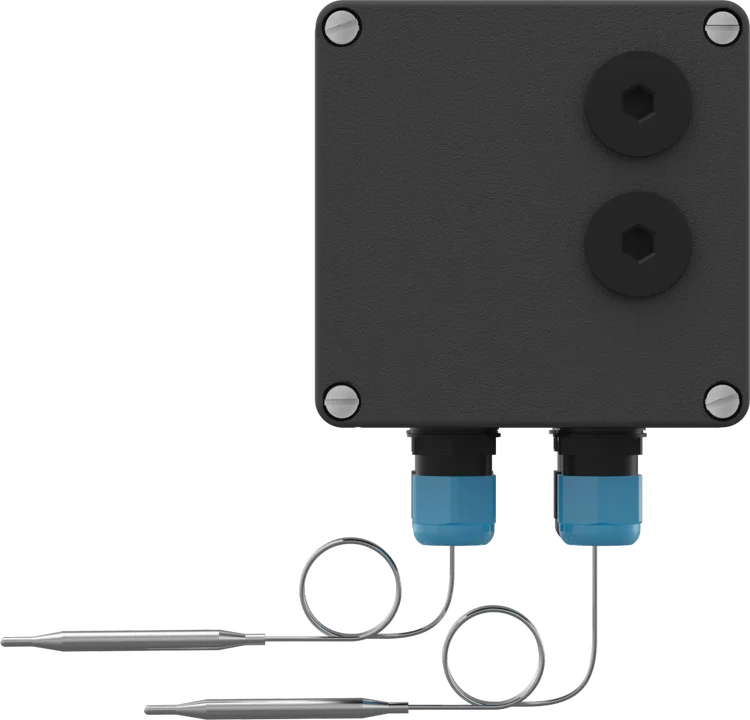
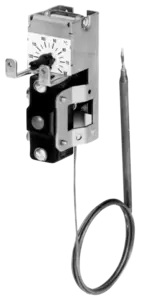
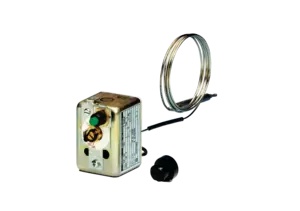
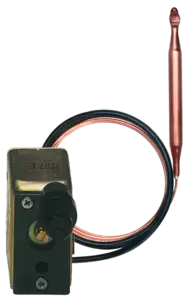
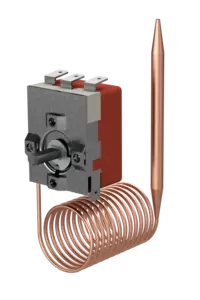
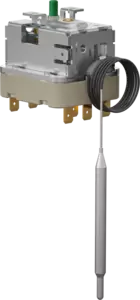
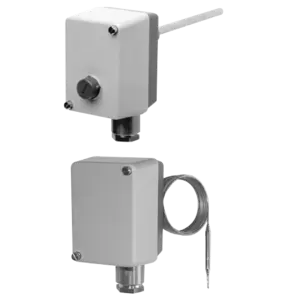
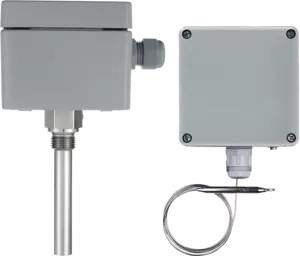
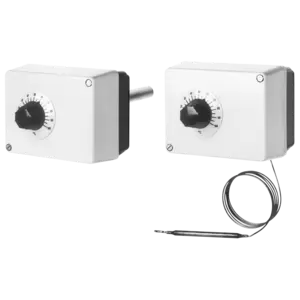
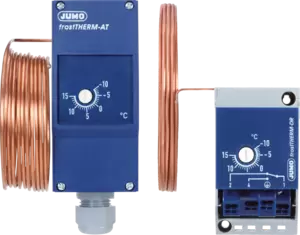
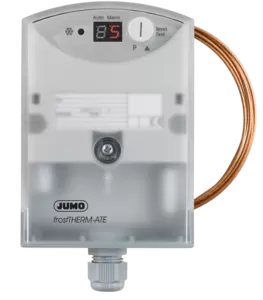
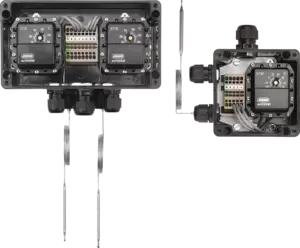
This type of temperature switch is usually called a thermostat, and it consists of a probe filled with gas or liquid that is placed into the process. If the temperature at the probe increases, the pressure in the system increases. Since the membrane is connected to the probe through a capillary line, the same pressure is created in the membrane. The membrane expands and the click switch is activated. The internal diameter of the capillary line 0,2 mm is only half the diameter of a human hair (up to 0,1 mm).
The probe and thermostat housing are connected to each other by a capillary tube. The maximum length of the capillary tube can reach 5 m. The switching point is usually installed on the housing.
Found: 19

No results were found for the selected parameters.
We offer not only industrial thermostats, but also comprehensive customized solutions, including feasibility studies.
Contact us!