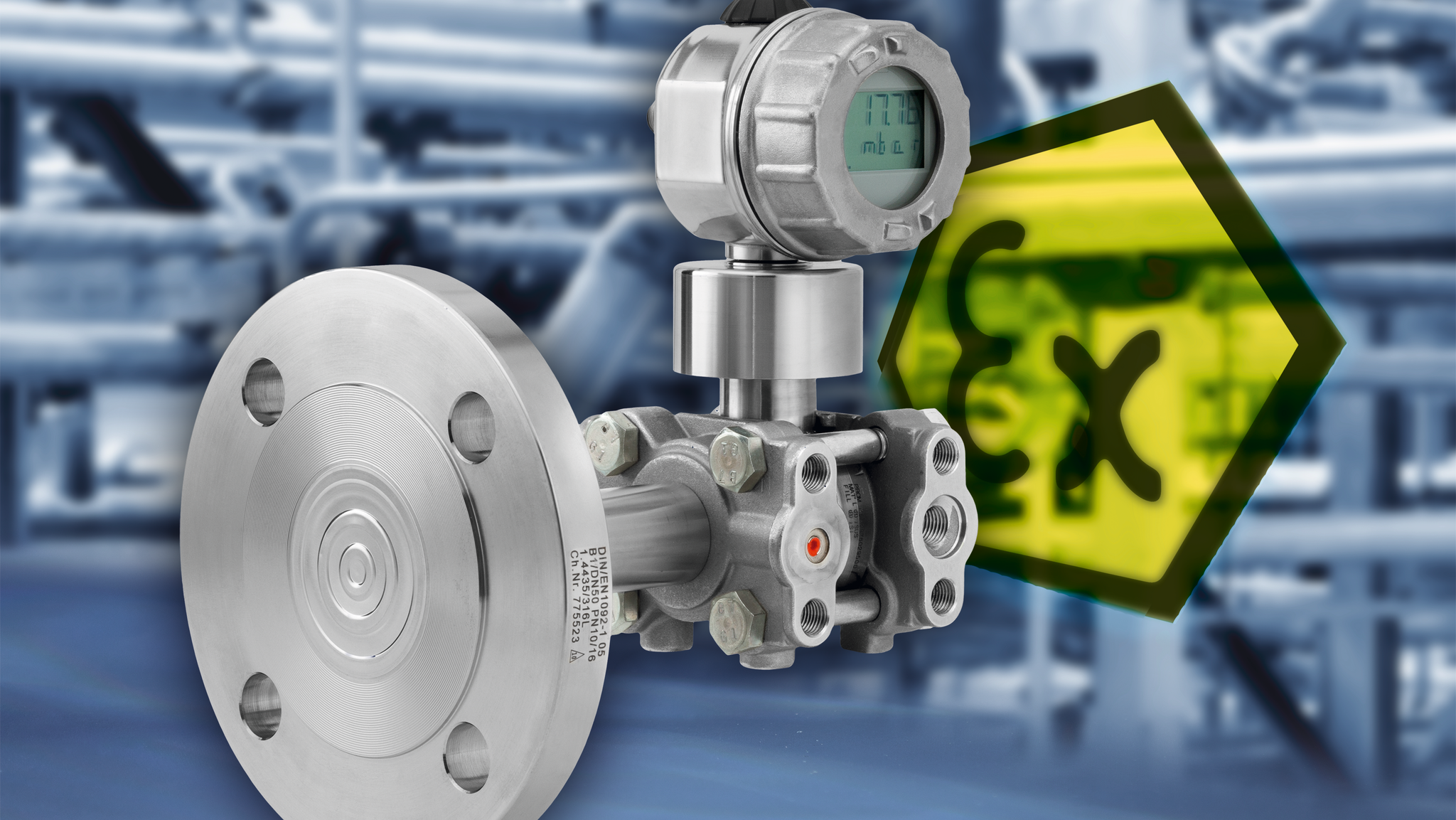
Differential pressure sensors: device, selection and application
Pressure measurement
Differential pressure measurements are used in many industrial applications, including control and optimization. After all, they provide information about the mutual relationship of 2 pressure ranges. For safe and reliable determination of pressure differences, special differential pressure sensors are used. Find out more about the operating principle, applications and features of smart sensors!Contents
What is a differential pressure sensor?
Differential pressure sensors measure the difference between 2 absolute pressures p1 and p2 in gases, steam and liquids. Other applications include filter monitoring, level measurement in closed containers, and safety-critical systems. They are often called differential pressure transmitters or differential pressure transducers.
How does a differential pressure transmitter work?
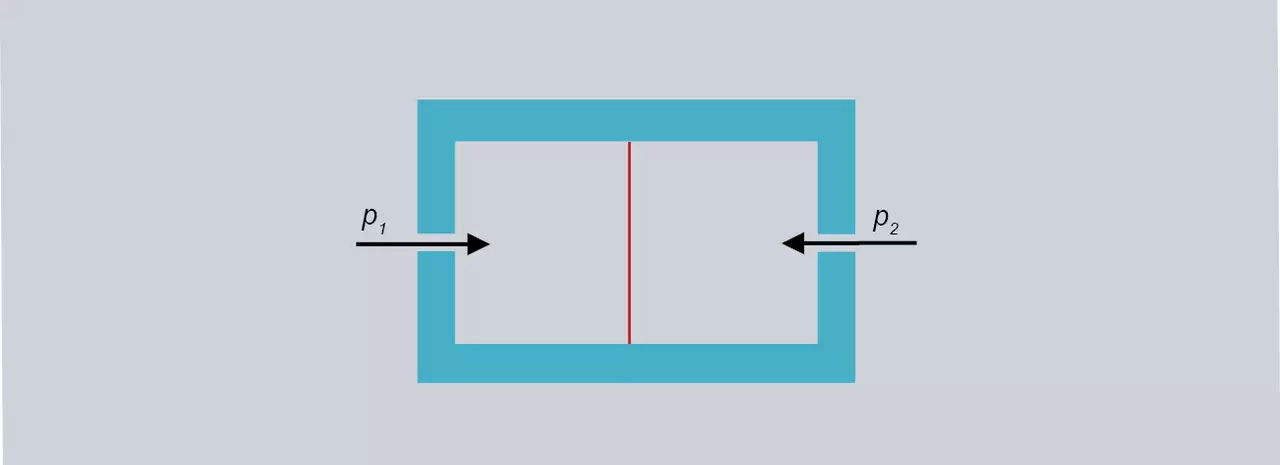
The differential pressure transmitter has 2 hermetically/airtight sealed chambers, each with a process connection, which are separated from each other by a flexible membrane with a resistance bonded bridge. The process connections are connected in front and behind the possible pressure reduction so that the pressures act on the membrane in the opposite direction. If the pressure in the chambers is the same, the membrane remains flat. When the pressure in one of the chambers decreases or increases, the membrane tilts towards the chamber with a lower pressure. The degree of deformation corresponds to the pressure difference 2: p2-p1=Δp. This can be detected by changing the resistance value, which can be converted into an electrical signal for further processing.
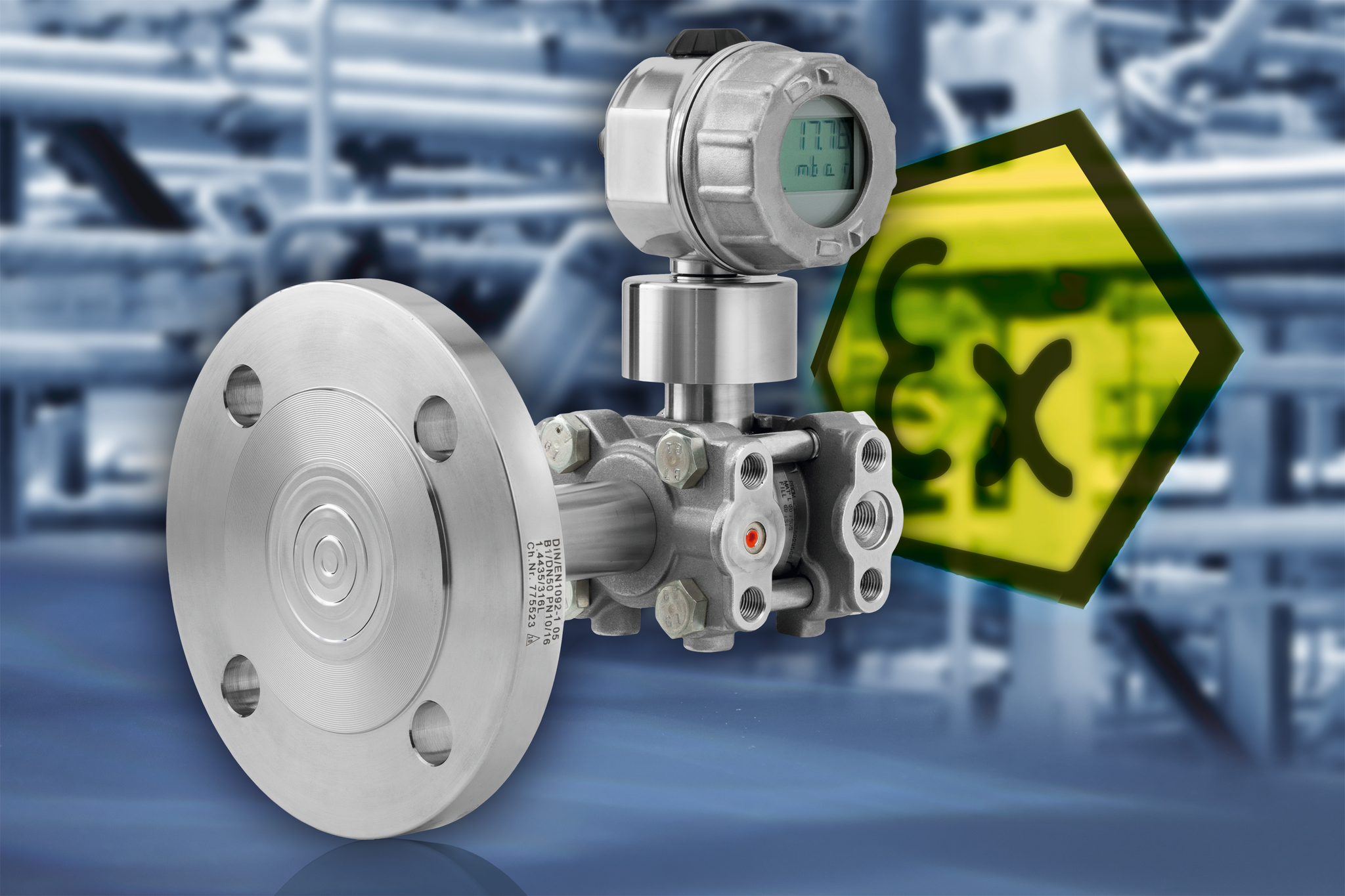
Differential pressure sensors JUMO
What types of differential pressure sensors are there?
A distinction is made between piezoresistive and capacitive measurement. Most differential pressure sensors today are based on the piezoresistive effect (change in electrical resistance of a material caused by stress or pressure). This effect is achieved by metal strain gauges, which are glued to the already mentioned elastic membrane, or by silicon wafers. Unlike strain gauges, sense resistors are embedded directly into the silicon membrane, so strain gauges do not require bonding. This improves measurement accuracy, heat resistance and durability. In addition, silicon sensors are significantly cheaper than thin film sensors. All piezoresistive differential pressure sensors are virtually drift-free.
Capacitive differential pressure transmitters have a capacitor built into the silicon chip, which allows inferences about the resulting pressure difference from changes in its capacitance.
Where are differential pressure sensors used?
Differential pressure sensors can be found wherever pressure relationships need to be continuously measured and verified (for example in filter monitoring or flow measurement).
Filter status monitoring
In ventilation systems, differential pressure can be used to determine the degree of contamination in the filter by measuring the pressure in front and behind the filter. The more dirty the filter element is, the more resistance it has to the medium flowing through it.
Flow measurement
Another application for differential pressure sensors is flow measurement in pipes. This differential pressure method requires a primary element to be installed in the pipe. Primary elements are available in a variety of designs. They narrow the cross-section of the pipe and thereby provide the flow medium with resistance determined by their geometry. This results in a local increase in flow velocity at the constriction point, which in turn leads to a change in static pressure before (p1 stat) and after (p2 stat) the primary element. Pressure connections for measurements are located directly in front and behind the primary element. The pressure difference is an indirect measure of flow.

How do the readings of the differential pressure transducer change during long-term operation?
Measuring instruments are subjected to a wide range of mechanical, thermal or chemical stresses, so that measured values change and become inaccurate over time. Zero offsets or hysteresis, for example, can lead to safety risks and reduced process efficiency. Regular calibration cannot prevent such changes, but it can detect them in time. For mechanical and electrical pressure measuring devices it is therefore recommended to carry out calibration Once a year.
Service JUMO

How to choose a differential pressure sensor?
Differential pressure sensors and differential pressure transmitters are available in numerous versions. Whether a sensor can be used in a particular application depends primarily on the minimum and maximum pressure levels that can be processed, the influence of the application environment, and the suitability of the environment. For example, capacitive pressure sensors lead to measurement inaccuracy in applications with high vibration; Not every sensor can tolerate aggressive gases and liquids. Depending on the type of application, certain permits are required. Examples include SIL 2/SIL 3 according to DIN EN 61508, PL according to DIN EN 13849 or explosion-proof version. If uncertain, detailed advice should be sought.
Devices and services JUMO