Temperature limiters - FAQ
Temperature measurement
Safety temperature limiters prevent overheating and, as a result, are critical to the protection of industrial plants. Their preventive function protects machines from damage and prevents personal injury. The following section FAQ provides additional information about these smart safety devices.What is a safety temperature limiter?
A safety temperature limiter is a temperature control device that automatically triggers a safety shutdown of the system when a set limit value is exceeded. It is available in different versions, can be tailored to specific requirements and environments, and helps you comply with legal standards. Commonly found on heat transfer oil plants, boilers and furnaces.
Buy safety temperature limiters
How do temperature limiters work?
Typically, a temperature controller controls the process temperature. If it rises to an unacceptable level due to a technical fault or incorrect operation, the safety temperature limiter intervenes. Combined with an electrical thermometer, it monitors the temperature and puts the unit into a safe operating state until the critical temperature is reached. This state is usually achieved by turning off the heat.
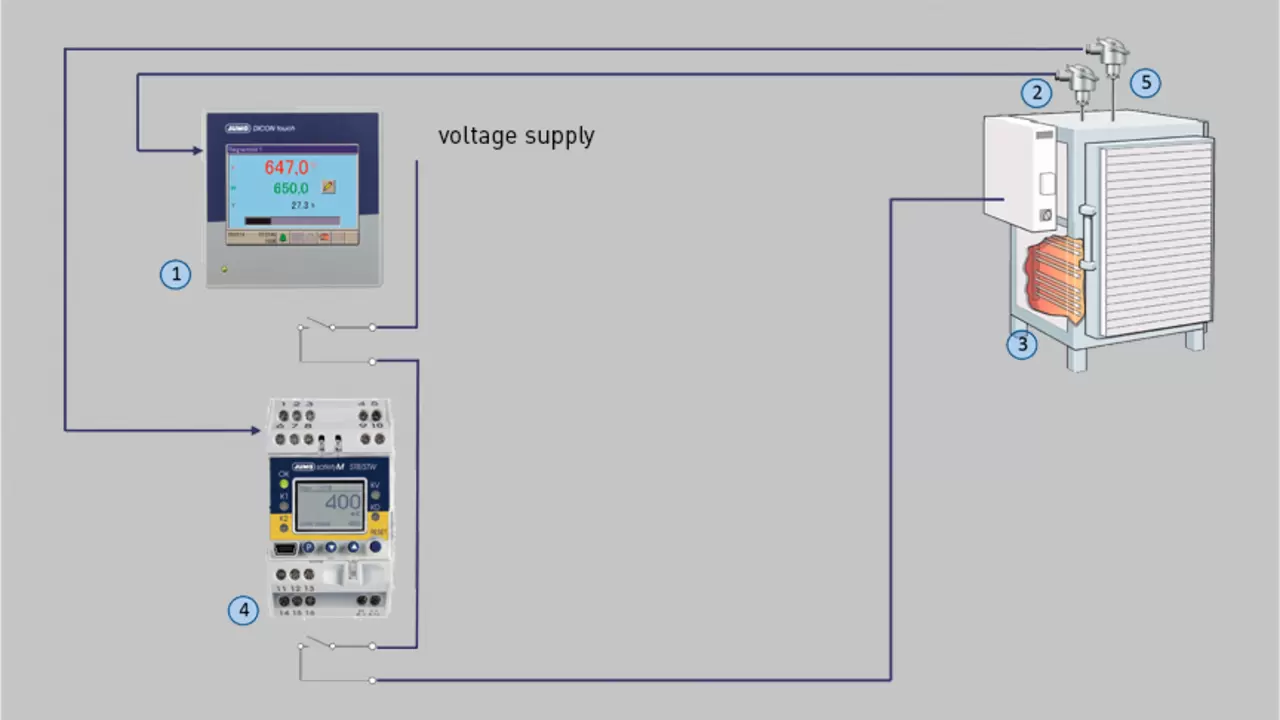
The image shows the temperature controller (1) which, together with the temperature probe (2) and heater (3), maintains the oven temperature at 650 °C. When heat is required, the controller closes the contact shown and heat is activated. The safety temperature limiter (4) measures the temperature using another temperature probe (5). For example, it only closes the contact shown at temperatures below 700 °C and only then provides heating. If the safety temperature limiter detects a temperature greater than 700 °C, it opens its contact (as shown in the picture) and the heating is switched off.
The controller and safety temperature limiter do not switch the voltage supply directly (contrary to the simplified figure) due to the high currents being switched. Instead, the controller controls the thyristor power switch and the safety temperature limiter controls the mechanical relay - these actuators then switch the voltage supply accordingly.
Can safety temperature limiters be used to monitor process variables other than temperature?
The analog input of the safety temperature limiter can be set to various sensors and signals. In this way, a signal such as 4 to 20 mA can be estimated. All process variables that are made available via the current signal can be controlled to minimum or maximum values (pressure, humidity, flow, etc.).
What is the safety temperature limiter reset mechanism?
Safety temperature limiters are equipped with a manual reset mechanism - for good reason: once the cut-out temperature is reached, the system should not automatically reset, but requires careful testing and approval by authorized personnel. This ensures that the cause of the excess temperature has been identified and corrected before the unit is restarted. This manual reset is mandatory for safety-related applications, which is the case in many heating installations, steam generators or industrial processes.
What is the difference between safety temperature limiters and temperature limiters?
Safety temperature limiters have a redundant design: the signal from the sensor is processed in 2 channels in the safety temperature limiter and compared with the limit temperature in each channel. Each channel has a relay that is activated only when the estimated process variable is within an acceptable range. The electrical circuits are connected in series so that the heating is turned on only when both contacts are activated. The diagnostic channel checks both evaluated signals for plausibility. Even in the event of an internal hardware error, the installation will not be released, so safe operation in this case remains possible. The redundant structure ensures increased safety of the temperature limiters, which is essential for high safety requirements.
In contrast, temperature limiters have no redundant structure and are used only for lower safety requirements.
In what temperature range can temperature limiters be used?
Depending on the sensor technology, temperature limiters can monitor a wide range of temperatures. Resistance thermometers with Pt100 Pt1000 sensors are often used at temperatures up to 600 °C. Thermocouples Type B thermocouple can be used to monitor the highest temperatures - typically up to 1500 °C.
Buy safety temperature limiters
Are thermostat based safety temperature limiters available?
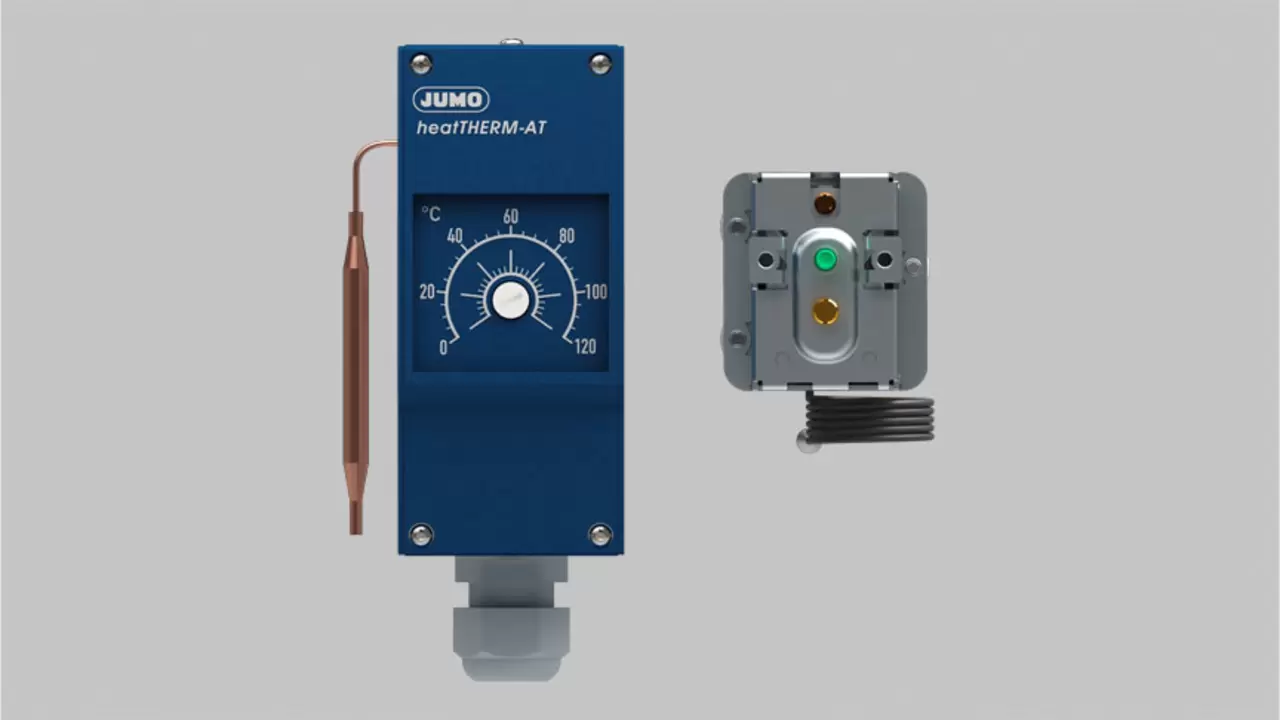
Temperature monitoring down to 650 °C can be achieved relatively inexpensively using electromechanical components. Safety temperature limiters and gas or liquid filled temperature limiters are available, including options with SIL 2 certification and Ex location suitability.
The switching point accuracy of the safety temperature limiters is dependent on tolerance and the switching point continues to be influenced by the ambient temperature. If the switching point must be precisely set in the application, this type of safety temperature limiter is not suitable.
Can safety temperature limiters work with sensor technology in areas of the former USSR?
Temperature must often be measured in an area where an explosive atmosphere may form. In this case, safety temperature limiters with approval ATEX are used, which supply only very low electrical power to the temperature probe. This prevents the temperature probe from becoming too hot and becoming an ignition source.
What legal rules and regulations apply to safety-critical applications?
Depending on the application, location and industry, different directives apply to the use of safety temperature limiters. Proper selection, installation and testing in accordance with these standards is mandatory and is often partially verified by testing or acceptance procedures carried out by experts (e.g. TÜV, DEKRA).
DIN EN 14579
This standard applies to electrical or non-electrical temperature control devices used to control temperature in heat generating installations. It describes the features that temperature control devices and temperature limiters must have in these installations. The standard is mandatory in many European countries.
DIN EN 61508
The DIN EN 61508 series "Functional Safety of Electrical/Electronic/Programmable Electronic Systems" is intended as a basic safety standard. Regardless of the application, it deals with the functional safety of systems. This is the central standard for the functional safety of control systems. The standard defines the requirements for systems that ensure the safe operation of installations.
In this context, the safety integration level (SIL), which is defined by DIN EN 61508 as the “medium probability of dangerous failures” (PFDavg), plays an important role. The general classification system consists of 4 levels (SIL 1 - SIL 4). In a system with SIL 4 the probability of failure (i.e. the PFDavg value) is extremely low. In a system with SIL 1, the probability of failure is significantly higher. If classification SIL is required for process installations, it is usually SIL 2 - rarely SIL 3.
Buy safety temperature limiters
How is the level SIL required for the safety device achieved?
The SIL classification is always based on the “average probability of dangerous failures”. An example here is a safety device designed to switch off in the event of excessive temperatures. This type of system typically consists of several components, such as a temperature sensor, a safety temperature limiter, and an actuator, for which manufacturers must certify the associated failure probabilities. The plant design engineer must calculate the overall failure probability of these individual probabilities and ensure that it is lower than 10-2 (per requirement) for SIL 2.
How are temperature limiters installed and maintained?
Safety temperature limiters must only be installed by authorized specialist companies. The temperature probe is installed in close proximity to the heat source (such as a boiler or heat exchanger) - ideally where the highest temperature that can be expected occurs. The probe is inserted into a suitable thermal block or directly into the medium.
Electrical connections must be made in accordance with the manufacturer's specifications and applicable codes. This usually occurs with a potentially free conventional open contact that only closes when the temperature is below a limit value. When the limit temperature is exceeded, the contact opens and heating control is interrupted.
To ensure proper operation, a functional test must be carried out after installation. Triggering is usually carried out using a test button on the safety temperature limiter, alternatively by heating the installation.
The safety temperature limiter must be maintained regularly to ensure operational safety. This includes visual inspections, annual functional tests and, if necessary, replacement in the event of aging, damage or malfunction. Tests must be documented.
How to choose the right temperature limiter for thermal processes?
Selecting the correct safety temperature limiter largely depends on the requirements of the specific application. The most important criteria include:
Temperature range
In the case of heating installations, the switch-off temperature is always higher than the normal operating temperature, but lower than the permissible maximum installation temperature. If the temperatures (eg operating temperature and switch-off point) are too close to each other, electronic safety temperature limiters are required due to the switching point tolerances, which switch exactly at the set temperature.
Thermostats designed as safety temperature limiters may be limited to a maximum temperature of 600 ° C. Higher temperatures preclude these systems.
In installations with rapid temperature rises, the safety limiter must measure the temperature with a minimum delay. Otherwise, the installation will turn off only after the permissible temperature is exceeded. Therefore, sensors with fast response times are needed. This can be achieved, for example, by using low-mass sensors and eliminating the need for additional protective sleeves.
Switching capacity
Safety temperature limiters typically control a power contactor and only switch extremely small amounts of electrical power. However, they also switch total power for heating on very small installations (e.g. 10A at 230V AC). In this case, it must be ensured that the maximum current is not exceeded.
Internal fuse for electronic safety temperature limiters
Electronic safety temperature limiters contain a fuse cutout that is connected along the same path as a normally open contact. If an unacceptably high current is carried through the fuse contact and cutout, the fuse is destroyed and the safety temperature limiter can no longer switch on the heating via its contact. This structure prevents the contact from being destroyed by overcurrent and therefore permanently closing, for example. If the fuse cutout is destroyed, the heating remains switched off, but the safety temperature limiter is then unusable and must be replaced.
Approvals and certifications
Safety temperature limiters are often integrated by plant manufacturers on their own initiative to protect the plant from damage. However, they are also mandatory in many cases and must have certain permits and certifications. Compliance with DIN EN 14597 is key for heat generation plants in Europe.
In potentially explosive areas such as the chemical industry or gas installations, approval ATEX is also mandatory.
Certification UL or CSA may also be required for export to the USA or Canada.
Additional important approval marks are the CE, VDE, TÜV or EAC marks, which certify compliance with national and international standards and the compliance of the temperature limiter with safety for the respective application.
Our services for you